Friday, March 8, 2013

Radiation

Hi as I update another ten examples of my next chapter Radiation, I would like to take a moment and thank everyone for viewing my page and hope that you are enjoying the blog ^_^.

-------------------------------------------------------
1. 

As always I like to start with something simple. This definitely portrays radiation as it has the basic centrifugal structure, in which the straight structural lines keeps your eye moving to the center of the picture.The angles of the lines that go to the center are equal.
http://pinterest.com/pin/218565388135315187/

2. 
This also follows the basic centrifugal structure. I was a little confused because of the middle left and right not looking like the others but it's just one side mirroring the other. This does not necessarily meant that they have hidden multiple centers, because the center remains the same for both, it's just a distorted center. 
http://pinterest.com/pin/77687162293027050/

3.
Speaking of off center this would be more of an example of a radiation that is very much so off centered. It's actually the sunlight above the tree which through the leaves, cast of rays which radiate and illuminate the entire picture.
http://pinterest.com/pin/4503668349552806/

4. 
Uniquely designed and representing a radiation with a curving or bending type structure. I love the optical illusion as the play on colors tend to make the picture vibrate and have a trippy sort of effect. Don't look to fast or you just may get sick (you have been warned lol).
http://pinterest.com/pin/86061042851560835/

5. 
The colors dash around the polygons and octagonal color spectrum gives off a nice rainbow effect to this radiation that has been open up in the center to this flower like center. The shapes around it also form concentric layers with centrifugal radiations. It's pretty neat how the person pulled the designed out with black and white focal point.
http://pinterest.com/pin/34691859599606553/

6.
Love how the rays of light radiate out of the house which tends to act as the focal point. The radiation has a directional change of the structural lines, where all the rays of light do not radiate to the same direction.
http://pinterest.com/pin/150800287493638857/

7.
Taking a bird's eye view of this I can see the ration would be more of  concentric layers of leaves that have many centrifugal radiations from the tip of the leaves. This once again have a directional change of structural lines and the subdivisions (each leaf) seems to be very repetitive.
http://pinterest.com/pin/280419514270480111/

8.
I must like concentric layers as I tend to have yet another picture that have many layer of circles  that open out from the center. Also the different forms within the value gives this a sense of superimposition as one dark concetric form is place upon the other lighter one.
http://pinterest.com/pin/33425222204436389/

9. 
This radiation takes on the structure that has many multiple centers. It is a collection of  off centered  radiation structures organized and pulled together to form a new radiation structure. This reminds of unit forms coming together to form a super-unit form within the design.
http://pinterest.com/pin/176977460328407288/

10.
Finishing this chapter off with a unique design this off  centered open structure that appears to spiral within the compressed lines. It looks like the opening of a colorful vortex.
http://pinterest.com/pin/91831279871342308/


Monday, February 25, 2013

Gradation

1.

A nice example gradation as you can see a slow transition from small oblong circles to larger ones or vice versa depending on the viewpoint. It's showing spatial progression as you can see that size changes in a backward sort of progression.

2. 

This cake has a parallel movement in which the unit forms transforms gradually in a straight line downward.  The many different degrees of gradation and the solid lines separates these areas into different segments of the same steps. 

3. 

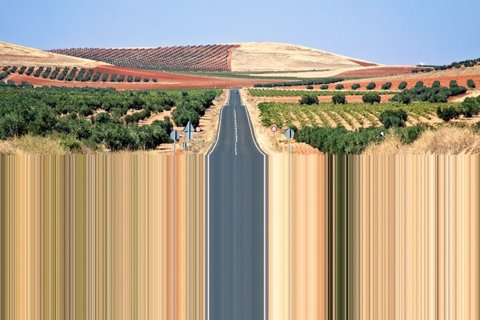
This definitely defines gradation as the bottom shows an optical illusion, creating a feeling of progression leading to a series of climaxes. This is spatial gradation by it's progression by also changing from different shapes (foreground of blurred lines, to clear picture presumed to be in background). The shape in the foreground (blurred lines) aslo tend to show tension as they look pulled outward. The speed of gradation was extremely fast due to it simultaneously drifting to blurred lines or vice versa.

4. 

Concentric movement is the main pattern for this gradation. The climax is in the middle and notice how the spatial progression pulls this back. This shows each layer moving in a slow gradation to the next, guiding the eye the main point in the enter.

5. 


If slowed down to show a smooth progression or transition, this gradation would quickly shift from the south western  to the north eastern corner of the plane signifying planar progression. The pattern also seems to direct toward moving in a zigzag sort of motion (as the tie curls or bends around to the next side).
6. 

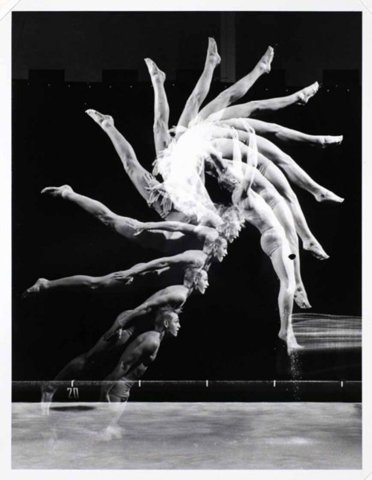
This picture of multiple images  share a shape gradation as each image added gradually transforms this into a unified composition. This looks like it was really fast due to the multiple images changing not to drastically, but enough to where it substantially  looks as if it happened in only an instant.

7. 

Just by changing the position or shape of each bone makes a rift in this composition. It makes it seems like it's going in many different directions at once or that it somehow zigzags.

8. 

Not much of gradation but the slight tip over to the right, and it's only a matter before gravity have it's course creating another movement.  The structure of course seems to be be curving or bending towards the right.

9. 

The slow transition between the oldest (biggest) the newest phone (smallest) gradually shows the spatial progression of this gradation. The decreasing size shows a shift ( or movement) of the phones moving backward and to the right.

10.

Let's finish this chapter of Gradation with a picture that has an all over type movement or in other words shape gradation. The lines tend to compress inward also making the picture seem elastic.


Sunday, February 24, 2013

Similarity

1.
Let's get started with a simple picture of corn. We have an idea shape of a piece of corn, but it's clear to see that though each piece is somewhat similar it's imperfect. Some pieces are disfigured, transformed, cut up, or even broken. The pieces of corn may not be identical or repetitive but they are none the less similar.

2. 
I thought this picture may have been another example of similarity. The font is different for "trust" and "your", and they even have different design concepts. They are similar by association, as you can see that they are all alphabets. However different by designs they manage to still contribute to the purpose.  No matter how much cognitive dissonance (different ideas : different designs) tries to get in the way and make you doubt yourself, "Trust Your Gut".

3. 

Let's add union into the mix of similarity. These two smaller and different color circles converge together to make what's similar to a Venn Diagram. I also like the two words that creates similarity to the middle zone or the little arrow to the side that says "Awesome".

4. 

I love how beautiful and creative the designs are that people tend to make. Especially this nice architecture that and architect has manage to make similar by what seems to be tension. This is when a form has been stretched (by an internal, or external (in this case) force, which pushes the contour outwards). Love how elastic they make this architecture look.

5.

The fingers actually show similarity in the sense of spatial distortion. However bent in a position (as you can see the hand is turned to the side), the fingers still can result in a many different spatial distortion.

6. 

Similarity doesn't just show up in shape it can also show up in the structure or in this case visual distribution of the composition. Visual distribution allows each unit form to be in the same amount of space as it would be judged by our perception. There seems also to be no guidance of structural lines.

7.

This picture really captures the saying "the eyes are the window to the soul", but I choose this picture just because of it's simplicity. The eyes albeit not exactly the same shape does have similar features that balance the weight on either side of the composition.

8.
I really enjoy how the circles seems to compress or draw the eye straight to the center, each circle getting smaller to the next. The similarity is definitely in the shape, no matter how the size differs. This also alludes to spacial progression of gradation but that is for the next chapter.

9.

I definitely want to say that this is similar by it's spatial distortion. Even when some of the parts of the bag is bent or twisted and no matter in how it is rotated, each bag still remains similar to the next.

10.

Let's leave this chapter of Similarity with taste. No matter what position turned in, they are also the same size just different depictions of the flower, and the envelopes leaves a nice sense of elegance to an example of similarity.


Monday, February 4, 2013

Super-Unit-Form & Sub-Unit- Form

Super-Unit-Form

1.

Perfect example of super-unit-form in my opinion because all of the repetitive shapes of people standing creates the image of a horse. I also like the white shirt people creating what I would assume to be the harness or lines of the horse face.

2.

This look like a pretty good picture that show a sub-unit-form. The spirals appears to shrink the further down it goes. This repetition looks like more like it's following an circular arrangement.

Unit Forms


Repetition

1.

Graphic I know but it makes a point to show our becoming status of today. Identity crisis and too afraid of hurting someone's ego many of us are slowly becoming like-minded (due to conformity) and weak. To describe the design aspect of it though, this repetition makes a good example of a unit form. This gives off an eerie harmony as the if you look at it for the whole picture it has a sudden flow or rhythm with the people wearing the same tattoo. It also has a directional variation as their heads seems to be pointing toward a focal point (cropped off) in the north eastern direction.

2.

Loving this natural design of a cactus plant that spirals inward or outward depending on the way you look at it. If you cut it in half it will definitely look just like a mirror image or a reflection.

3.

There is repetition in the shape itself as well as the lines on the figure. I love how the arms create the lines of force as it appears she may be dancing. Just for randomness she also looks like the singer Florence from the group Florence and The Machines.

Friday, January 25, 2013

Form As Plane

1.

Well let's start of with this picture. It has no specific point and the lines are molded into to form this unique plane. I would say that this has a geometric shape for the way the scenes are boxed in, almost done with a mathematical precision.

2.

This oblong shape has no precise calculation on lines or points so it can't be considered geometric. I rather say this forms an irregular plane as it has straight and curve lines but does not form them, this picture definitely forms a irregular plane.

3.

These irregular shiny silhouettes make a nice form of a plane. They scream accidental as you could guess the sun shined on a weird chandelier or Mosaic structured windows, or were they strategically place there?

4.

This example of a plane is very rectilinear due to the random amount of rectangles in the picture like the backing of the couch or the huge windows forward. The other random shapes makes it feel a little organic also.

5.

What an odd way to form a plane but the corners and edges of this room pulls together, and draw your attention straight to the woman (can also be form of point) and her feet turning on the water. Love how realistic this is, I would like to think that this picture was definitely started off hand drawed.

6.

A very curvy form it looks like the have of an apple and the reflection helps to form a plane. It has no definite shape so that leaves a pretty good estimate of being organic.

7.

No clear establishment between the point of the iron cage in the center (form of point) or the walls appearing to cascading downward (form of line). This definitely leads into the geometric range of forming a plane, because this looks very much calculated. It also appears to be rectangles because the many shapes are rectangles in this piece.

8.

With few perspectives in this picture one stand out the most and that is upward. This is a good form of plane because this could be irregular due to the bar on the side and the steps not really being mathematically equal.

9.

I can't focus on anything right now, it seems there are random objects placed everywhere and there e is no definite focal point. This definitely have to be and organic type of plane due to the lines being curved or straight and suggesting growth. I wonder what could pop up next in the front of the objects in this picture.

10.

The last of this project this picture is a form of a plane because of it's geometric outlay of what appears to be windows. They all look mathematically place and this was drawn from a certain perspective to make the lines look calculated.


Thursday, January 24, 2013

Form As Line


1.

Lead me forward ballet dancers as you overall form a line straight to the next window. This picture speak rhythmically to me as the next dancer is doing something different from the last.

2.
Look a the rows are chairs forming a waving line. The thickness of the chairs do not change but once again overall this forms a line that has a character of it's on.

3.

Loving the variation of thinness and thickness of these lines as they separate off into their own little swirls. Very artistic I might add, it reminds me of wind that has no direction and is free flowing.

4.

This peaceful picture has form as line as extremities of the trees evoke the sense of a line being there. You can almost draw an imaginary line between the trees.

5.

As each ray points to the south eastern corner they form a line that forces our eye to move along that path. I wonder where would this lines actually meet.

6.

Amazingly enough this storm forms as a line as you can see the varied thin and thickness of the lightning bolts.  A fascinating fact about that is some of the discharge can form little balls of electricity, that legends say may chase you. A line transforming into a sphere right in front of your eye will definitely be a site to see.

7.

It's phenomenal to see some of  natures designs by just a simple walk on the beach. I notice that the overall picture depicts a wavy line that seems to stretch on forever.

8.

Lines come in all shapes and sizes, even in "model" size to be exact. It could be from the the overall picture as you see here, from the actually body of the line being a line, or the imaginary (a.k.a extremity of a line) which forces you to envision a line. 

9.

All lines don't have to stay in one direction and follow a straight path. Some lines have a what I call a different personality and they form with varied thickness or thinness to another direction or form.

10.

Lines can and will go any direction, sometimes they may have an ending and other times they won't. You will have lines with thickness and then you will have thin scrawny lines. Either  way the way to establish a line will be by the overall shape, the body of it, and the extremity or imaginary pull of the line.